Wrought iron handrails for London steps and stairs
Wrought iron handrails are one of the most useful things you can add to a London house. Front door steps on period terraces are often steep, worn in the middle and slippery in the rain. Basement stairs are narrow and dark. A firm metal handrail makes them safer for everyone, from small children to older parents, and a well made one looks as if it belongs to the house.
We design, make and fit handrails for front steps, basement and lightwell stairs, garden steps and staircases inside the home. Each one is made to measure, forged in our own workshop and installed by our London team.
What we make
Front door step handrails
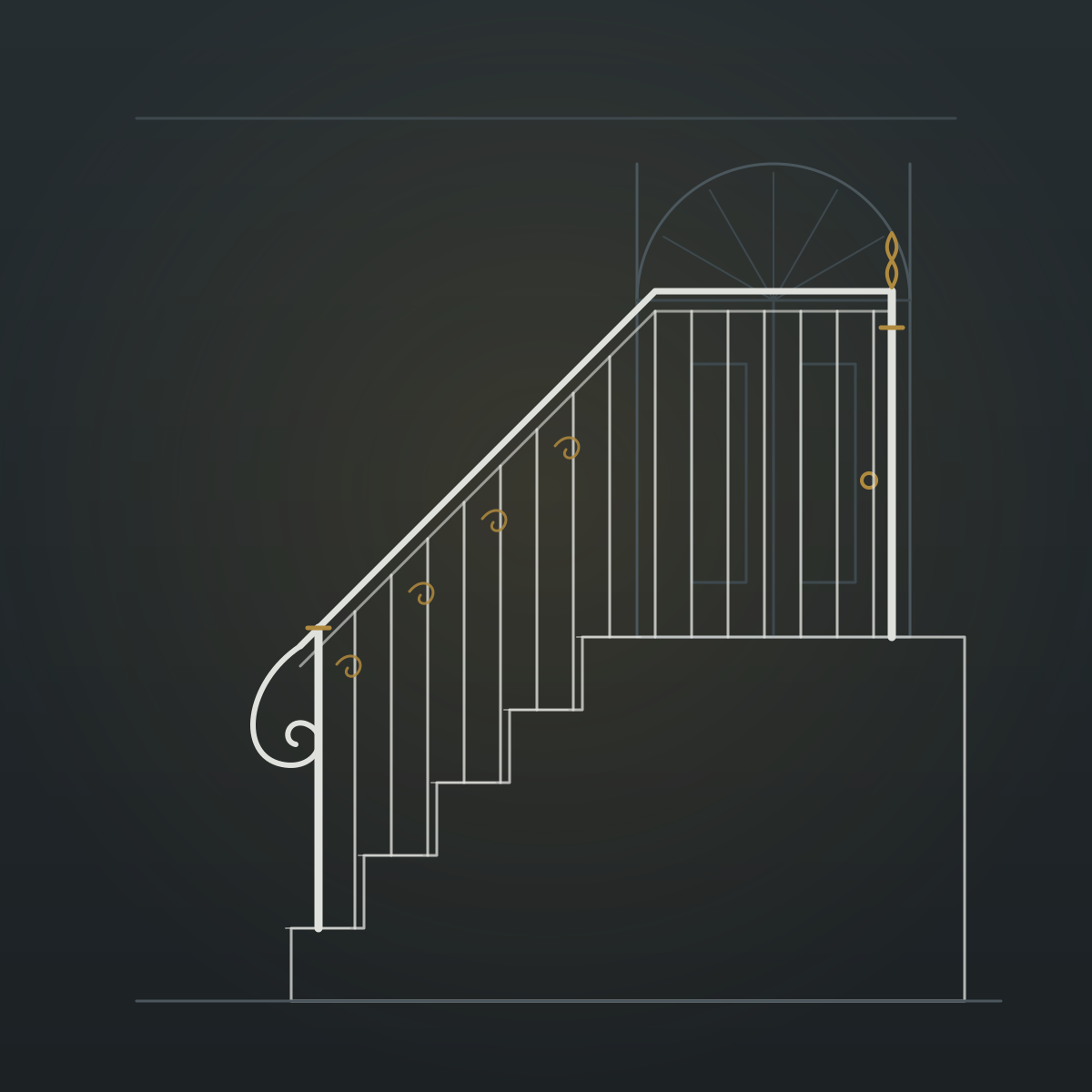
This is the job we are asked about most. A single rail runs up beside the steps on two or three posts and ends in a scroll or a neat return at the top. On a period house we can match the bar size and finials of the railings next to it, so the handrail and the railings look like one design.
Basement and lightwell stairs
Many London houses have steep stone steps down to a basement door. Here a wall-mounted rail on brackets often works best, because there is no room for posts. Where one side of the steps is open, we add balusters under the rail to make a proper guard.
Handrails inside the house
Inside, a metal handrail can be a quiet modern line or a shaped rail with forged ends that matches an iron balustrade. If you want a full balustrade with bars, scrolls or panels, see our staircase balustrades page.
Getting the details right
Most of the comfort and safety of a handrail comes from small details.
- Height. Approved Document K, the government guidance on stairs, says a handrail in a home should be between 900mm and 1000mm above the pitch line of the steps. We set it there and check it with a level on site.
- Something to hold. A rail needs a section you can wrap your hand round. We shape round and moulded profiles that are comfortable to grip, not a sharp flat bar.
- Clear of the wall. Wall-mounted rails sit far enough off the wall that your knuckles do not scrape.
- A safe end. Rails finish in a scroll, a monkey tail or a return into the wall or post, so a bag strap or sleeve cannot catch.
- Firm fixings. Posts are set into stone or fixed with resin anchors chosen for the material. Old stone can crack if it is drilled carelessly, so we look at it first.
Finishes
Outdoor handrails are galvanised and then painted, which keeps rust out for many years. Black satin is the usual choice on period houses. Inside, we offer painted finishes, waxed black metal, bronze effects and gilded details on scrolls or collars.
Repairs to old handrails
If you already have an iron handrail that is loose, rusted at the base or missing its scroll, it can often be saved. We cut out rusted sections, reset loose posts and make new parts to match. Our railing repairs and restoration page explains how we work on older ironwork.
How it works
- Survey. We visit, measure the steps and walls, and look at the stone or brick the rail will fix into.
- Design. We agree the profile, the ends and the finish with you, and match any railings nearby.
- Making. The handrail is made in our own workshop and finished before it comes to site.
- Fitting. Our London team fixes it in place and checks it is firm before we leave.