Smith Square and early Georgian Westminster
Tucked behind the Houses of Parliament is one of the best early Georgian corners of London. Smith Square was developed by Sir James Smith in the 1720s. At its centre stands St John’s, a Baroque church by Thomas Archer, begun in 1713 and finished in 1728. It was gutted by a bomb in 1941 and stood as a ruin for over 20 years. It reopened in 1969 as a concert hall and is now called Smith Square Hall.
The streets running off the square are lined with plain brown brick houses. Lord North Street was built around 1720 to 1725. The houses have wooden doorcases, panelled doors and stone copings on the parapets.
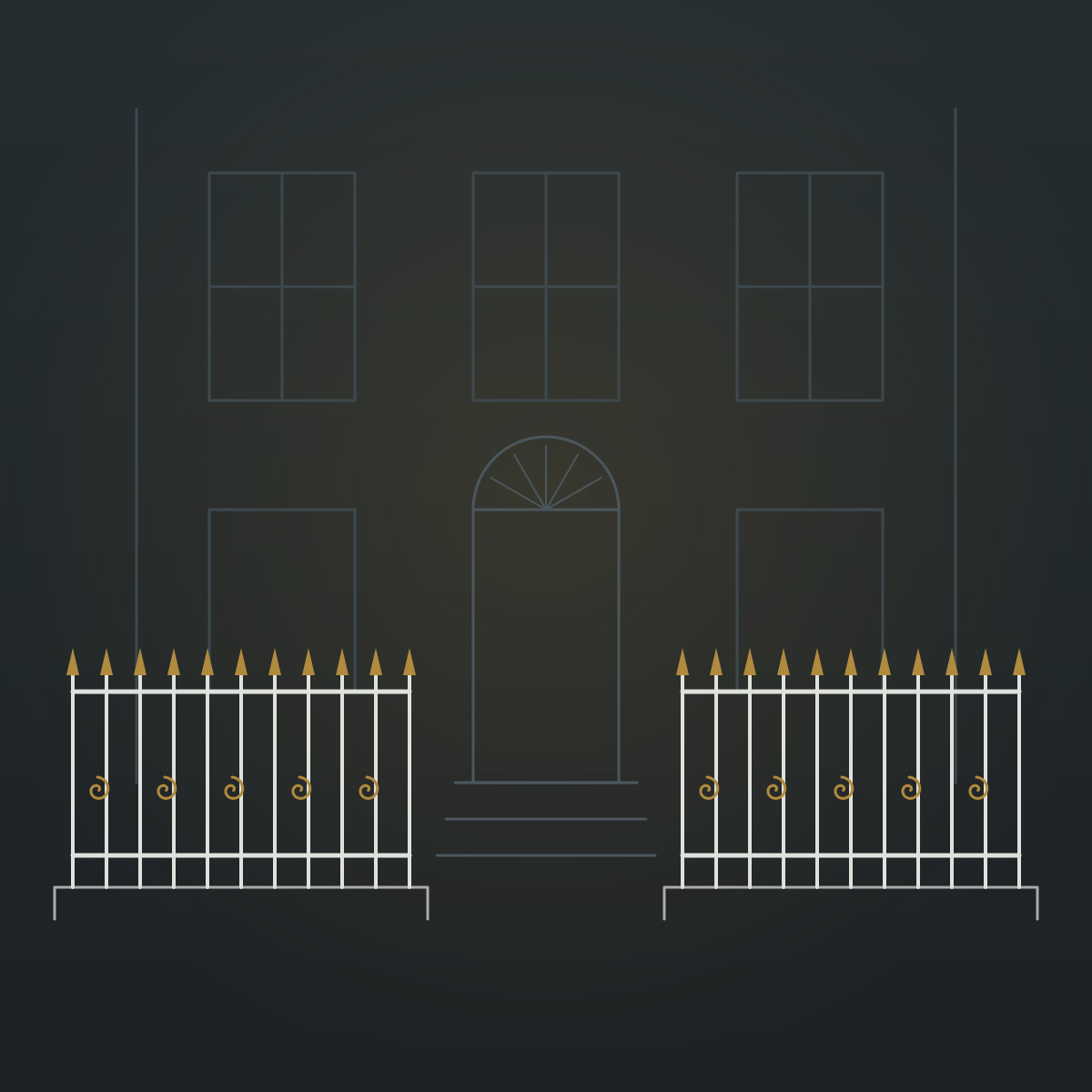
What makes this corner special for us is the ironwork. The listing for Lord North Street describes fine original wrought iron area railings, with scrollwork supporting torch extinguishers and urn finials. At 7 to 9 Smith Square, built in 1726, the railings have scrollwork beside the entrances and the remains of link extinguishers. These were cone-shaped snuffers that torch carriers used to put out their flames at the door.
Pimlico: Thomas Cubitt’s stucco grid
Pimlico was low, marshy land on the Grosvenor estate. In 1825 Lord Grosvenor brought in Thomas Cubitt, who had already built much of Belgravia. Cubitt raised the ground, partly with earth dug out for St Katharine Docks, and laid out a grid of white stucco terraces. The largest houses were on St George’s Drive and Belgrave Road.
The squares are the high point. Warwick Square was laid out in 1843, with four and five storey houses, Doric porches and balustraded first-floor balconies. Eccleston Square and St George’s Square are among Pimlico’s best addresses too. Around Warwick Square’s garden, the railings and stone plinths were taken away in the Second World War. New ones went up in 1999. The garden gate has an overthrow, an arch of iron over the gate, with the words “Rus in Urbs”.
Most Pimlico houses sit above a basement. Each has a run of area railings along the pavement and a small gate down to the basement steps. Walk down most Pimlico streets and you see the same railing repeated house after house. That repetition is the point, so any new length has to match.
Ironwork we make for SW1
Area railings
We forge railings to the exact pattern of your terrace. We record bar size, spacing and finials on site, and copy them closely.
Heritage restoration
For early Georgian houses near Smith Square, keeping old ironwork matters most. We repair scrolls, refix loose bars and forge only what is missing. Where a terrace has lost its railings, we can reinstate them using a surviving neighbour as the guide.
Balconies
Pimlico’s first-floor balconies sit over the porches. We repair these and make Juliet balconies for rear and side windows. Guarding on a balcony outside must be at least 1100mm high.
Gates and institutional railings
Offices, churches and schools in SW1P often need longer runs of railings and wider gates. We make these to suit the building and its security needs.
Building work around the ironwork
In both areas, the railings are set into a stone plinth along the edge of the basement area. When iron rusts inside the stone, it swells and cracks it. Fixing the railing without fixing the stone does not last.
We can replace cracked plinth stones and reset the copings. Pimlico basement steps can be badly worn, and lightwell walls are often patched. We can rebuild steps, repair the lightwell and make good the stucco around the porch after work. On the brick houses of Lord North Street, any repair to the brickwork beside the railings is matched to the old brick. One team does it all, so the stone and the iron are planned together.
Planning and consent in Westminster
Westminster City Council is the planning authority. Smith Square and the streets around it form the Smith Square Conservation Area. Pimlico has its own Pimlico Conservation Area, first designated in 1968 and extended in 1973 and 1990. It protects both Cubitt’s grid and the later estates such as Churchill Gardens.
A conservation area is a place the council protects for its history and looks. New or changed railings at the front of a house there usually need planning permission. Many houses in both areas are listed, and then listed building consent is needed too. Please check the rules for your building with the council before any work is booked. We provide scaled drawings and a written specification for the application.
Design: from our album or bespoke
You can choose from our design album of hundreds of proven railing patterns and adapt one to your house. For Smith Square restoration work, we usually draw the design from the surviving railings so the new parts match. Nothing is forged until you have approved the drawings.
How a commission runs
We survey the front, photograph the ironwork and check the plinth, steps and lightwell. We agree the design and help with any council consent. Each piece is hand-forged in our own workshop, and our London team installs it. Parking near Smith Square and on Pimlico’s squares is tight, so we book bay suspensions in advance where needed.
If you own a house near Smith Square or a Pimlico terrace that needs railings, repairs or a balcony, request a quote and tell us about it.