Museums first, then the terraces
South Kensington took its modern shape after the Great Exhibition of 1851. Money from the exhibition bought land south of Hyde Park, which became the museum quarter often called Albertopolis. The Royal Albert Hall opened in 1871. Alfred Waterhouse’s Natural History Museum opened in 1881, close to what became the Victoria and Albert Museum, the Science Museum and Imperial College.
Builders lined the streets around them with some of London’s grandest stucco terraces. Queen’s Gate runs south from Kensington Gore, and numbers 53 to 64 date from about 1856 to 1859. Charles James Freake developed Onslow Square and Onslow Gardens on the Smith’s Charity estate. Thurloe Square and George Basevi’s Pelham Crescent belong to an earlier, quieter phase. In the 1880s Ernest George and Harold Peto designed red-brick houses in Harrington Gardens and Collingham Gardens.
What the ironwork looks like
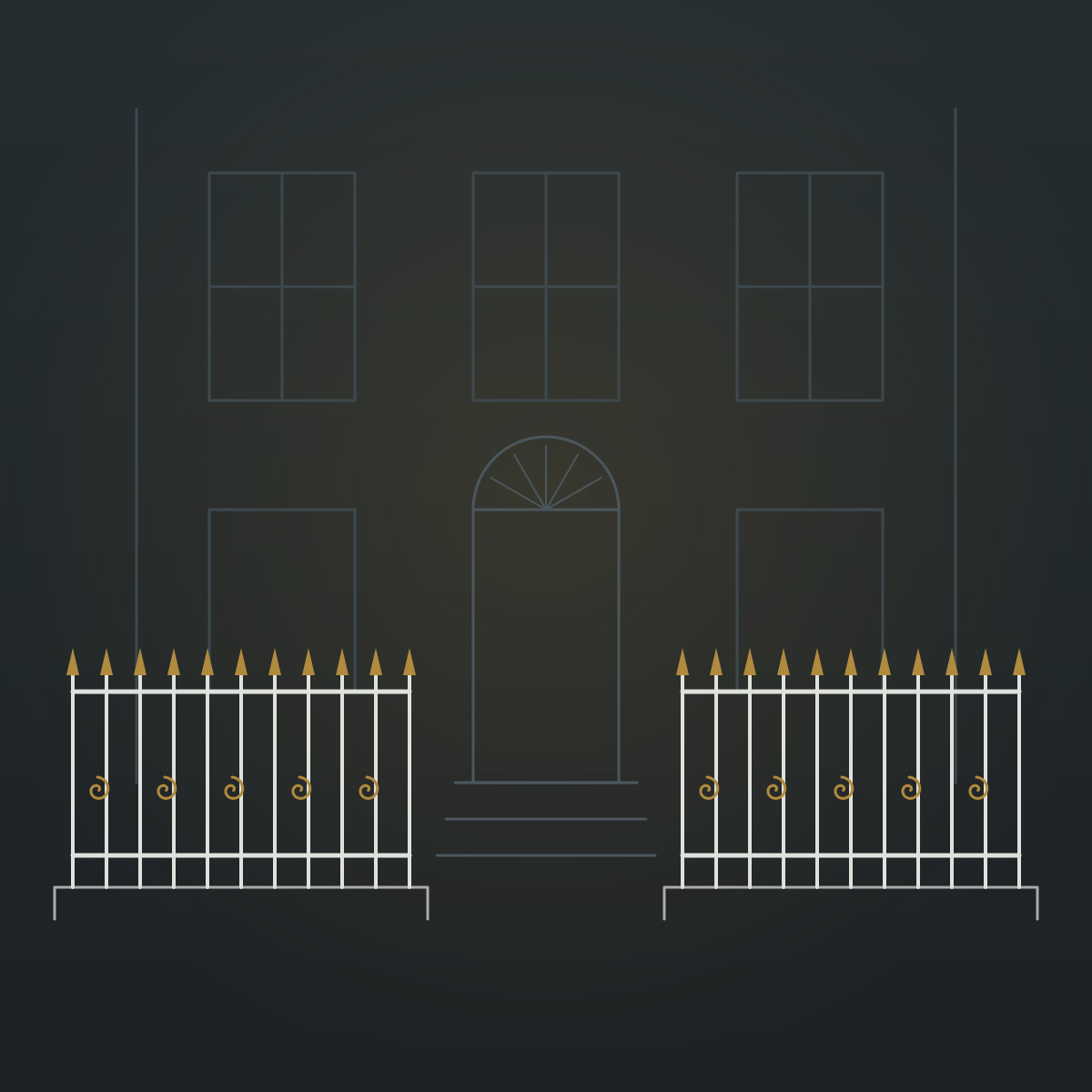
The stucco terraces repeat the same parts house after house. Deep basement areas, the sunken yards in front of the lower ground floor, sit behind cast iron railings. Columned porches mark each front door. On Onslow Square, the listing for numbers 2 to 42 notes Doric porches and a cast iron balcony at first floor.
Queen’s Gate is grander. There the listing for numbers 53 to 64 describes cast iron area railings. The balconies above, though, are part of the stucco front itself, with columns and balustrades. That matters if you are replacing ironwork, because the iron has to sit well against heavy stucco without competing with it.
Harrington Gardens and Collingham Gardens are another world. Each red-brick house is different, and the ironwork there is more individual. Many terraces along Cromwell Road, Harrington Road and Queen’s Gate are now hotels, flats or college buildings. That brings canopies and wide internal stairs into the picture.
Ironwork for South Kensington
Area railings
We forge replacement railings for the deep basement areas of Onslow Gardens, Queen’s Gate and the streets between. Bars and finials are copied from the survivors. A finial is the ornament on top of each bar. Gates and stair rails down to the basement are made at the same time.
Balconies
Where a cast iron balcony on an Onslow Square terrace has cracked or lost a panel, we make new panels to match. Juliet balconies, which are a rail across a tall window with no platform, suit the rear elevations and the mews behind Queen’s Gate. On a balcony you can step out onto, guarding must be at least 1100mm high under the building regulations.
Canopies and stairs for hotels
Hotels in the converted terraces along Cromwell Road and Harrington Road often need a canopy over the entrance or a balustrade for the main stair. We plan the work around guests.
Restoration
Original railings that survive can usually be repaired. Missing finials and bars are forged to match.
Deep basement areas and stone steps
South Kensington’s basement areas are deep, and the walls holding up the pavement edge carry a lot of load. When railing fixings rust, they swell and crack the stone copings along the top of those walls. Our craftsman is also an experienced builder, so we handle that work too. We reset copings, repair the area walls and rebuild worn porch steps, so the new railings have a solid base. You do not need a second builder for the stonework.
Consent in South Kensington
The Royal Borough of Kensington and Chelsea handles planning across SW7. The main conservation areas are Queen’s Gate and Courtfield, towards Gloucester Road. There is also the Thurloe Estate and Smith’s Charity Conservation Area, around Thurloe Square, Onslow Square and Pelham Crescent. A conservation area is a part of town the council protects for its character. Changing railings, balconies or canopies on a front there usually needs planning permission.
Many terraces are listed. Listed building consent, which is permission to change a protected building, then covers the railings too. The council expects new ironwork to keep the uniform look of each terrace. Check with the Royal Borough before you commit to a design.
The Smith’s Charity estate around Onslow Square has its own approval process. Freeholders, managing agents and hotel owners usually need to approve both the design and the fitting dates. We prepare drawings that work for each of them.
From drawing to fitting
You can start with a pattern from the craftsman’s album, which holds hundreds of proven designs, and adapt it to your terrace. For canopies and hotel stairs, we can draw a fully bespoke CAD design with you or your architect. You approve the drawings before any forging begins. Every piece is forged in our own workshop by a craftsman with 20 years of hand-forging behind him, then installed by our London team.
Cromwell Road is a busy through route, and the museum streets fill with visitors. We book parking bay suspensions on quieter side streets, which keeps the space free for us to unload. The ironwork comes in sections that can be carried to the door.
If you are planning railings, a balcony, a canopy or a staircase in South Kensington, request a quote or call us.