The oldest corner of Canonbury
Canonbury’s story starts with a tower. Canonbury Tower was built around 1509 by Prior Bolton of St Bartholomew’s Priory in Smithfield, as a country retreat. It still stands on Canonbury Place, and from 1952 it was leased to the Tower Theatre company.
Next to it, Canonbury Place was built in the 1770s by John Dawes, a stockbroker who leased the land from the Marquess of Northampton. These are some of the earliest Georgian houses in this part of Islington.
Canonbury Square came later. Henry Leroux of Stoke Newington began the north-west side in 1805, again on Northampton land. Building went on until about 1830. A new turnpike road, now Canonbury Road, was cut through the middle around 1812 and split the square in two. Many of the Georgian houses around it are listed. George Orwell lived at number 27b, and Evelyn Waugh wrote his first novels at 17a.
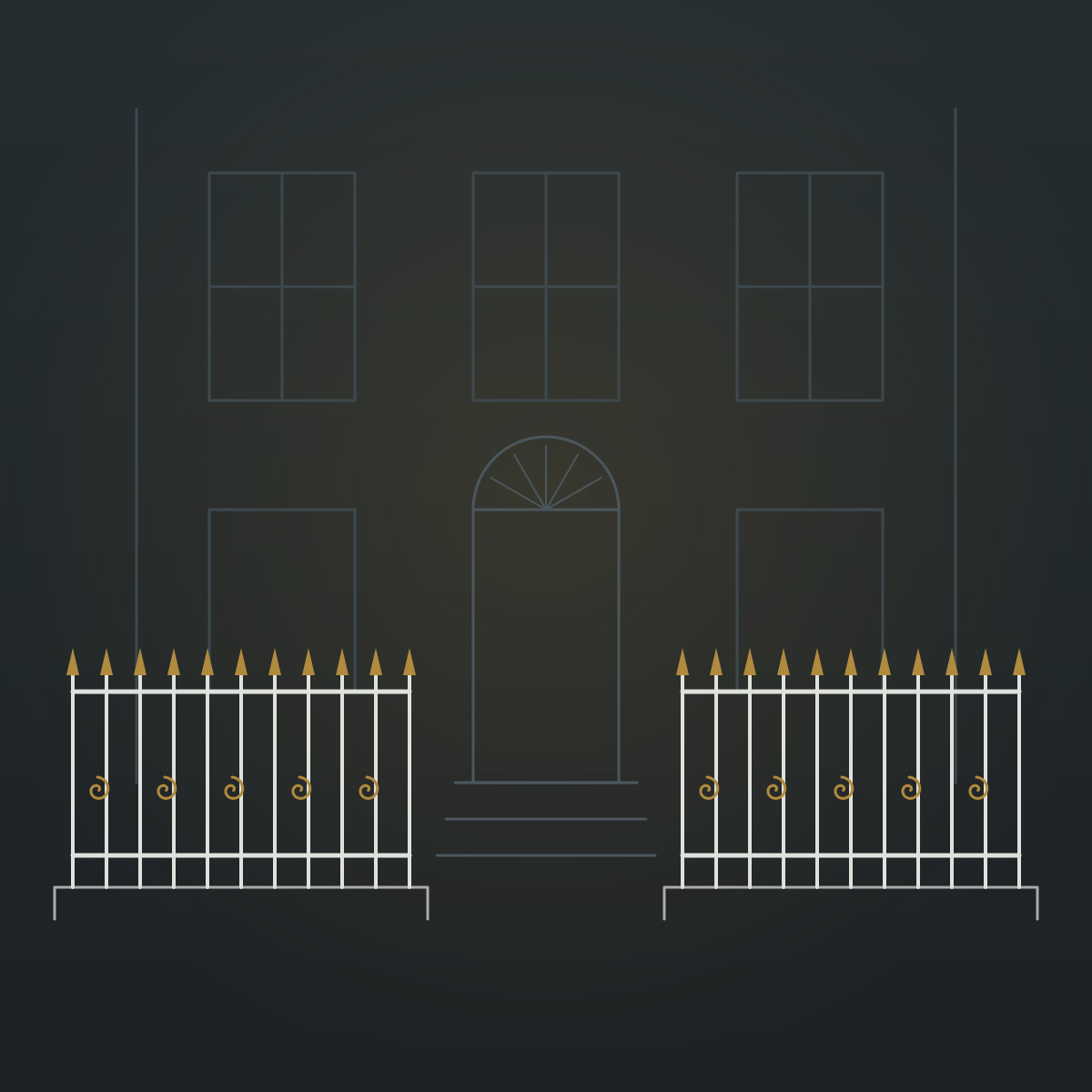
On the main road to the west, Compton Terrace was built between 1803 and 1809. At Nos 19 and 20, the listed area railings still carry spearhead and urn finials.
Highbury Fields and its terraces
Highbury Fields is the largest open space in Islington, at about 11.75 hectares. Its edges are lined with some of the best Georgian houses in north London.
Highbury Place came first. John Spiller, a builder from Southwark, put up its 39 houses under an agreement made in 1773, with leases granted between 1774 and 1779 by the landowner John Dawes. Highbury Terrace followed, with a date stone of 1789 on its central part. Both terraces look straight out over the grass.
Highbury Crescent is different. It was laid out in 1844 with pairs of big Italianate villas, decorated in stucco. Further east, Aberdeen Park and Highbury New Park filled with large Victorian villas from the 1850s.
What the railings look like
Georgian railings here tend to be simple. The Compton Terrace listing is a good guide: area railings along the basement, with spearhead and urn finials. Gates lead down to the basement or up to the front door. The Victorian villas of Highbury Crescent and Highbury New Park are a different type of house, so their front boundaries need a different approach.
The Canonbury Square garden shows how much was lost in the 20th century. That is why matching and restoring matter so much here.
Ironwork for Canonbury and Highbury homes
Restoring original railings
If your railings are old, we would rather save them. We repair rusted bars, forge missing finials and fix loose sections back into the stone. Only parts that are past saving are replaced.
New area railings
Where railings were lost, we forge new ones to the pattern on your terrace. We copy the bar size, spacing and finials from a surviving neighbour.
Front gates
We make gates for basement steps, front paths and villa gardens, with forged bars and finials to match the railings.
Balconies
We repair first-floor balconies and make Juliet balconies for tall Georgian windows. A Juliet balcony is a rail across a window with no platform.
Building work around the ironwork
The stone plinth under the railings is often the real problem. When iron rusts inside the stone, it expands and cracks it. On streets this old, plinths have often been patched before.
We can cut out and replace cracked plinth stones, reset copings and rebuild the brick dwarf wall, which is the low wall a railing sits on. We also repair worn stone front steps, tidy up basement lightwells and rebuild front garden walls at Highbury Crescent villas. On a brick terrace, we match new brickwork and pointing to the old as closely as we can. The same team handles the iron and the masonry, so the railing goes back onto a sound base.
Planning and consent in Islington
Islington Council is the planning authority. Canonbury Square, Canonbury Place and Compton Terrace sit within the Canonbury Conservation Area. The streets around the park are in the Highbury Fields Conservation Area.
A conservation area is a place the council protects for its history and character. New or changed railings at the front of a house there usually need planning permission. Many houses in both areas are listed, and then you need listed building consent as well. Please check the rules for your house with the council before work starts. We supply scaled drawings, photos and a written specification to support the application.
Design: from our album or bespoke
You can choose from our design album of hundreds of proven patterns and adapt one to your house. For restoration we usually draw the design from the railings that survive on your terrace, so old and new match. For a villa, we can draw a fully bespoke design with you. Nothing is forged until you approve the drawings.
How a commission runs
We survey the front, photograph the ironwork and check the plinth, steps and walls. We agree the design and help with consent if needed. Each piece is hand-forged in our own workshop, and our London team installs it.
If your Canonbury or Highbury house needs railings restored or replaced, request a quote and tell us about it.