A neighbourhood of small squares
Barnsbury sits on the slope west of Upper Street. It was built up between the 1820s and the 1850s as a patchwork of small estates. Each landowner laid out a square of their own, so within a few minutes’ walk you pass half a dozen very different ones.
Cloudesley Square came first, built from 1826 to 1829. In its centre stands Holy Trinity Church, designed by a young Charles Barry long before his work on the Houses of Parliament. The square’s railings were taken in the Second World War and restored in 1980.
Gibson Square was laid out by Francis Edwards for Thomas Milner Gibson, with houses of the 1830s around a garden. Lonsdale Square followed from 1838 on land owned by the Drapers’ Company. Its architect, Richard Cromwell Carpenter, used Tudor Gothic rather than classical fronts, which makes it unlike anything else nearby.
Milner Square is stranger still. It was designed by Robert Lewis Roumieu and Alexander Dick Gough, with the east side built from 1841 and the west side finished around 1850. Its tall, narrow windows and strong vertical lines give it a stern look. The houses are listed together with their attached railings.
Further north, Thornhill Square was begun around 1847 and finished in 1852. Its garden railings date from about 1852 and survived the war, when so many squares lost theirs.
What the ironwork looks like here
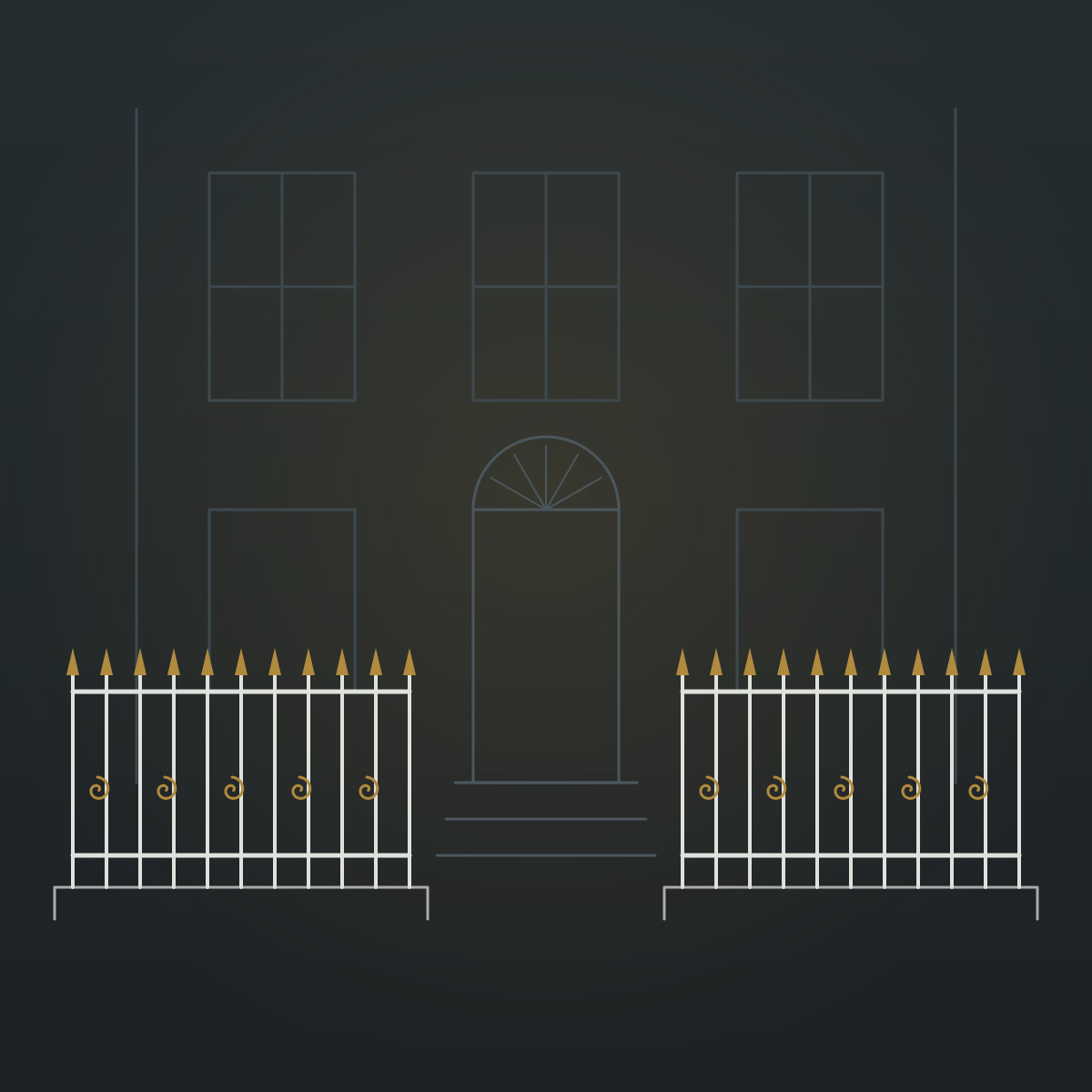
The standard Barnsbury house has a basement area, which is the sunken yard in front of the house, guarded by railings set into a stone plinth. Stone steps rise over it to the front door. A light balconette often sits at the first-floor windows. The squares add a second layer: garden railings around the central planting.
Because so many railings went in the war, Barnsbury is full of patchwork. Lonsdale Square’s were copied again in 1970 to 1971. Gibson Square’s garden got new railings in the 1970s. Individual houses often have a mix of old bars, later repairs and plain modern panels along one frontage.
Ironwork for Islington and Barnsbury homes
Restoration
Where old railings survive, restoring them is usually right. We repair rusted bars, refix loose ones and forge replacements only where we must. Old and new are then finished together so the run reads as one.
Front and area railings
To fill a lost run, we record the bar size, spacing and finial from the same terrace and forge new lengths to match. Where two neighbours share a run, one drawing can serve both houses.
Garden gates
We make gates for front paths and basement steps, designed to sit with the railings on either side.
Balconies
Balconettes for Barnsbury’s first-floor windows are drawn in light Georgian and early Victorian patterns. On an external balcony the guarding must be at least 1100mm high, and no gap may let a 100mm ball pass through.
The building work around the railings
On a Barnsbury terrace the railings are leaded into a stone plinth or a low dwarf wall. When a bar rusts at its base, it swells and cracks the stone around it. We can lift the railings, rebuild the dwarf wall or plinth, repair worn front steps and make good. The restored railings then go back on solid work, and you only deal with one team.
Planning and consent in Islington
Islington has many conservation areas. A conservation area is a district the council protects for its historic look. The Barnsbury Conservation Area covers Gibson, Lonsdale, Milner, Thornhill and Barnsbury Squares. Nearby, the Duncan Terrace/Colebrooke Row, Cross Street and Canonbury Conservation Areas protect more Georgian streets.
A large share of Barnsbury terraces are listed, often with their railings. Changes to them need listed building consent, which is permission from the council to alter a protected building. Even on unlisted houses, the council expects traditional designs and finishes. Please check with Islington before you commit. We provide measured drawings and a specification for your application.
Design, forging and installation
You can pick a pattern from our design album, which holds hundreds of proven Georgian and Victorian designs, and we adapt it to your house. For restoration we often draw a bespoke design in CAD, based on the surviving railings on your terrace. Nothing is forged until you approve the drawings.
Your ironwork is forged in our own workshop by a craftsman with 20 years of hand-forging experience. It is installed by our London team, with parking and delivery arranged ahead.
If your railings on Thornhill Crescent need saving, or a gap on Gibson Square needs filling, request a quote with our short form or call us.