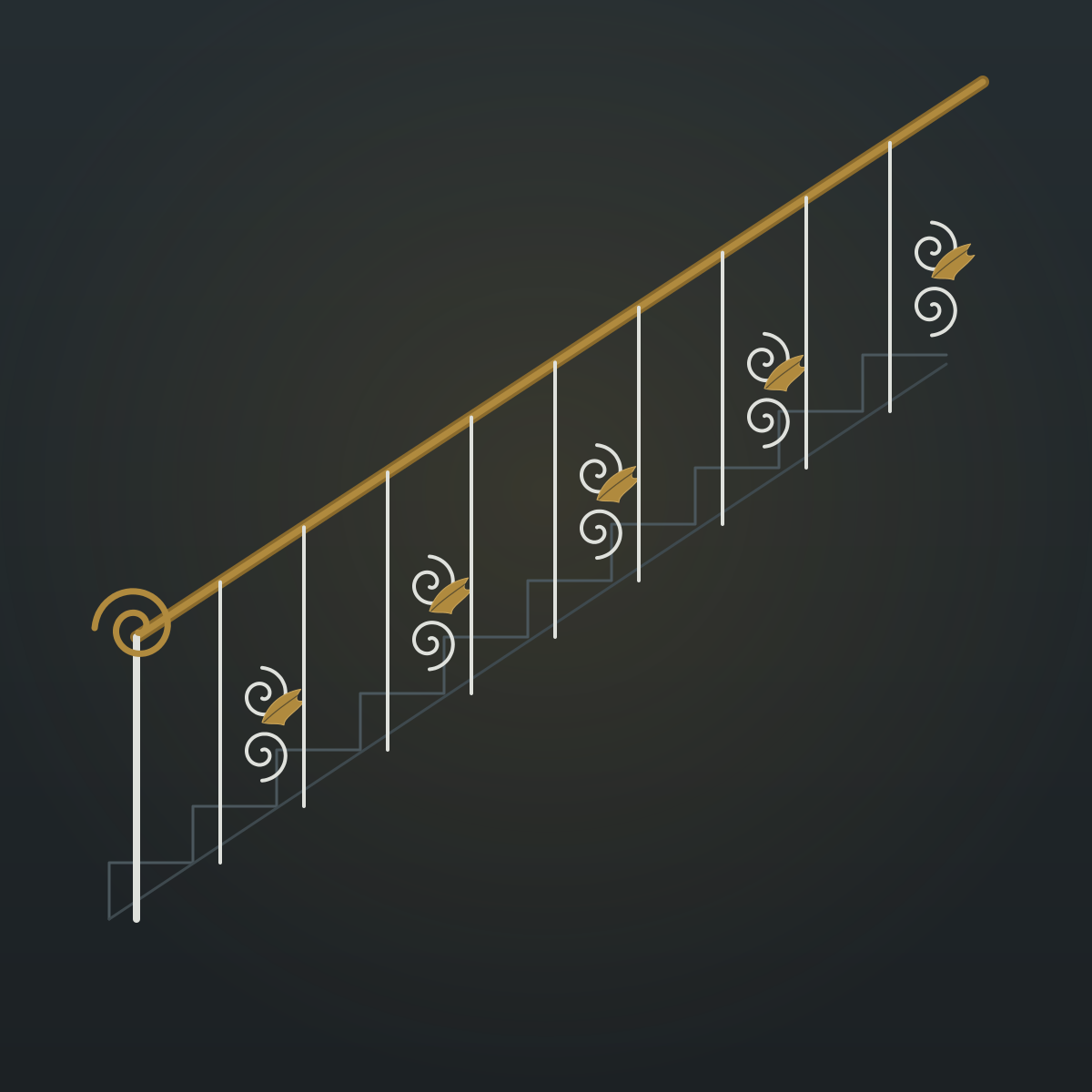
A balustrade worth looking at
In a lot of London houses, the staircase is the first thing you see when the front door opens. In a Georgian townhouse it climbs four or five floors around an open well. In a Victorian villa it turns at a half landing under a tall window. In a newly remodelled home it may be the one piece of sculpture in a calm, plain interior.
A hand-forged balustrade gives that staircase real presence. We design and make:
- Balustrades inside the house, running up one flight or several.
- Landing and gallery balustrades around stairwells and open voids.
- Feature panels at half landings, galleries and the foot of the stair.
- Handrails in oak, brass or leather on forged balusters.
- Railings and handrails outside for front steps, basement stairs and gardens.
We design each balustrade with you and forge it in our own workshop. Our London team installs it. Every piece is made for one particular stair.
Forged by hand or assembled from stock
Most ready-made balustrades are put together from standard parts. Pressed collars, cast leaves and stock balusters get welded together. The result can be neat, but it often feels generic. You also see the joins up close, and you will be up close every time you use the stair.
Hand-forging shapes the steel hot on the anvil. Scrolls are drawn out and rolled. Leaves are formed by hand from the bar. Collars are wrapped round each joint while hot. Balusters can be twisted, tapered or swelled out to suit the design.
Our craftsman has 20 years of hand-forging experience. That includes gilded acanthus leaves and scrollwork that follows the slope and turn of a stair.
Signs of forged work
- Scrolls that taper to a natural end rather than stopping square.
- Forged collars round each joint, not ground-down welds.
- Leaves with life. Each one is a little different, with veins and edges worked by hand.
- Ironwork that follows the stair. Changes of slope and turns are formed in the bar itself, so the line flows instead of stepping awkwardly.
Materials
Our balustrades are hand-forged mild steel. Almost all decorative ironwork made today is. True wrought iron has not been made commercially for decades. When we restore an old balustrade, we can sometimes use reclaimed or re-rolled wrought iron where matching material makes sense.
Handrails
The handrail is the part people touch every day. It deserves as much thought as the ironwork.
- Oak is warm and traditional. It can be shaped to classic profiles, such as a round mopstick rail. It sits on a forged steel core rail and is usually made with your joiner or stair builder.
- Brass gives a crisp line. Left unlacquered it slowly takes on a soft patina. Lacquered, it keeps its shine.
- Leather is hand-stitched over a steel or timber core. It is soft to hold and suits modern and hotel-style interiors.
- Forged steel, finished to match the balusters, suits simpler or more industrial schemes.
Choosing a design
Starting from the design album
Our craftsman’s design album holds hundreds of proven patterns. They run from plain Georgian balusters to rich Victorian scrolls, Art Deco shapes and modern forms. Picking a pattern and adapting it to your stair is a good way to see how a design will really work.
A design drawn for you
You can also have a design drawn from scratch. We work it up with you and, if they are involved, your architect or interior designer. It might pick up a shape from a fireplace, a plaster ceiling or a fabric. It might add gilded leaves at the half landing.
We prepare CAD drawings, which are exact computer drawings to scale. They show each flight from the side, the landings and turns from above, the baluster spacing, the handrail shape and the fixings. Nothing is forged until you approve them.
Feature panels and landings
Feature panels put the decoration where people see it most. That is usually the foot of the stair, the half landing or a gallery over the hall. Plain forged balusters with one or two rich panels can look more striking than decoration all the way up. It is often quicker to make, too.
Safety and regulations
A balustrade in a home has to be safe. We design to the guidance in Approved Document K, the government document that covers stairs and guarding.
- Guarding height. On stairs, guarding is usually at least 900mm above the pitch line. The pitch line is an imaginary line joining the front edges of the steps. Internal landings and floor edges also need at least 900mm. Outside, balconies and roof edges need 1100mm.
- Handrail height. Stair handrails usually sit between 900mm and 1000mm above the pitch line.
- Gaps. No gap should let a 100mm ball through. That includes gaps inside decorative panels and under the bottom rail.
- Climbing. Where young children may live, the design should avoid horizontal bars that are easy to climb.
- Loads. The balustrade and its fixings have to take the pressure of people leaning on them. So we plan fixings into the stair and floors with care.
Where an architect or building control is involved, we agree the details with them. On a listed building, changing an original staircase or balustrade normally needs listed building consent. That is permission from the council to alter a protected building.
Working with joiners and stair builders
Most balustrades are fixed to a stair made by someone else, so planning together matters. We agree with the joiner or stair builder:
- Where the fixings go, whether into the strings (the side boards of the stair), the treads or the face of the stair.
- Baluster spacing to suit the size of the steps.
- How the newel posts and handrail meet, especially where an oak rail runs onto timber posts.
- The order of work on site, so finished surfaces are protected.
It is best to bring us in while the stair is still being designed. We also fit to finished stairs after a careful survey.
Sometimes the work goes beyond the ironwork. A new stair may need an opening formed in the floor, or the walls may need making good after fixing. Our team handles that building work as well.
Restoring an old balustrade
Many London houses still have their original stair ironwork. Some of it has been painted over many times. Some was partly lost when the house was split into flats. Before replacing anything, it is worth asking if the old balustrade can be repaired.
- Missing sections can be forged to match the balusters and panels that survive.
- Damaged scrolls and collars can often be repaired rather than replaced.
- Thick old paint can be stripped back to show the crisp detail again.
- Low historic guarding can sometimes be made safer with discreet additions. We agree these with you and, on a listed building, the conservation officer.
If the original balustrade has gone completely, we look at the period, the stair and similar houses nearby. Then we design a replacement that feels as if it belongs.
Finishes
Inside the house, the finish is mostly about looks and wear.
- Paint in black or a colour of your choice, over a suitable primer.
- Powder coating for a smooth, hard-wearing finish.
- Waxed or lacquered bare steel that shows the hammer marks and the colours left by the forge.
- Gold leaf on leaves, collars or finials.
Railings for outside steps get an outdoor system. That means a zinc layer, from galvanising or zinc spray, with primer and paint or powder coating on top.
How a job runs
- Visit. We come to the house to see the stair and the interior, and to hear how you live there.
- Survey. We measure the stair, landings, walls and fixing points.
- Design. We adapt an album pattern or draw a new one, then send CAD drawings for approval.
- Quote. We price the agreed design, handrail and finish.
- Forging. We forge the balustrade in our own workshop, with a trial fit where it helps.
- Fitting. Our London team installs it, working around your joiner, decorator and other trades.
Looking after your balustrade
- Dust and wipe painted or powder coated ironwork with a soft, damp cloth.
- Feed oak handrails with a suitable oil or wax now and then.
- Polish brass, or leave it to darken, depending on the finish you chose.
- Clean gold leaf gently and never with anything abrasive.
- Check the fixings now and again, especially on landings and long runs.
Request a quote
Planning a new staircase, remodelling a hall or replacing a tired balustrade? Request a quote through our short online form, or call us to arrange a visit.